22 January 2026
Look what they made you do: How brands control January
January. The month of misery, darkness, and self-enforced regulation. The month that lends itself to memes about its endlessness. The month where brands control people like puppets.
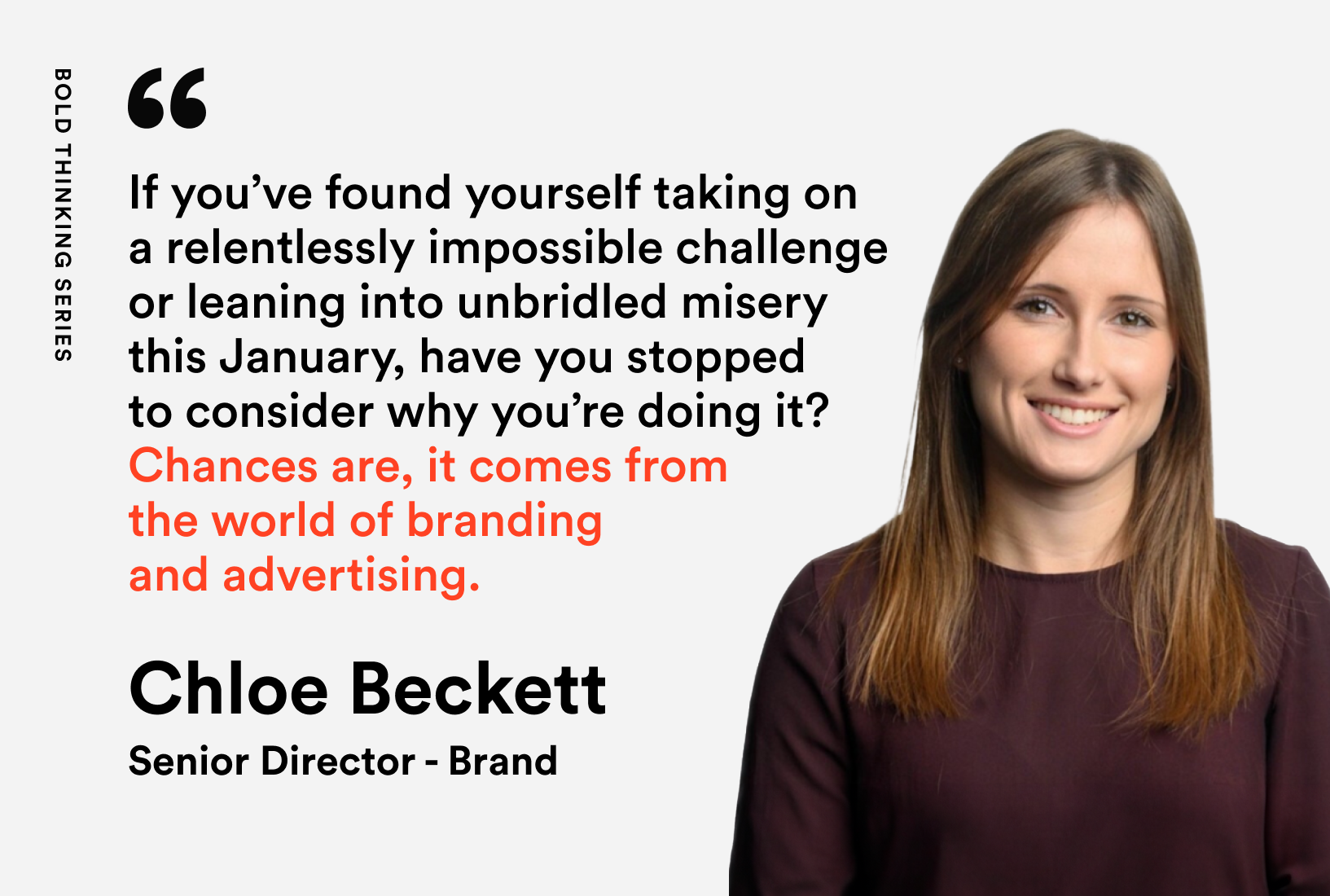
If you’ve found yourself taking on a relentlessly impossible challenge or leaning into unbridled gloom this January, have you stopped to consider why you’re doing it? Chances are, it comes from the world of branding and advertising.
Consumers start the year feeling over-indulged yet motivated to change, making them uniquely vulnerable to the influences of marketing. The psychology is fascinating. The strategy is revealing.
Here’s how brands can take control.
Blue Monday: a branded feeling
Although capitalising on the very real sense of shared gloom in January, Blue Monday is in fact a complete marketing invention. Coined in 2005 as part of a PR campaign for Sky Travel (and by our very own Senior Creative, Ade), it marks a pseudo-scientific estimation of the most depressing day of the year (thanks Ade).
The science may not quite hold up, but the idea has stuck.
By naming a shared emotional low point, Blue Monday gives people permission to feel bad, and crucially, to look for relief. And once the feeling has a name, it becomes a moment that brands can respond to.
Travel companies offer escape. Wellness brands offer coping. Employers offer pastries.
The lesson for brands is not to invent sadness, but to recognise when an emotional state already exists, give it language – and position your brand as the answer.
Dry January: a collective experiment
While variants of ‘sober January’ have existed at least since the Second World War, the UK’s first modern ‘Dry January’ was marked by Alcohol Change in 2013, led by activist Emily Robinson. Hardly a marketing ploy, this was a public health campaign.
But ever since, brands have quickly understood its usefulness. Gyms, sleep apps, and wellness platforms align themselves with the benefits of clarity and control. The low and no category gets a cultural hall pass to come out of Christmas hibernation. And every January, Lucky Saint delivers a creative punch as strong as its beer is weak.
For brands, this is a masterclass in time-boxed behaviour change. Dry January lowers the cost of trying something new; it has a start date and an end date; and it has social proof built in.
So if you want your customers to try something unfamiliar, January is when they are most open to temporary rules, especially if you can convince them that everyone else is at it.
Veganuary: a new identity
Veganuary sits in a similar space, but with a sharper identity angle. This trend is itself a brand; a nonprofit organisation set up by vegan activists in 2014.
The brilliance of Veganuary is that it turns a moral choice into a low-risk experiment, and removes the pressure of perfection. Food choices are deeply tied to values, culture, and self-image – but while asking someone to go vegan forever is confrontational, asking them to try it for January is a challenge.
For vegan and non-vegan F&B brands alike, the opportunity in January is clear: flood the shelves with limited edition plant-based flavours and variants. Look at Greggs – it was no accident that they first trialled their celebrated vegan sausage roll on the third day of January.
It works because January is when people are most willing to borrow an identity. In this month, curiosity peaks and trial matters more than conversion. Brands that offer a safe way to try on new values can win long-term relevance, even if the behaviour doesn’t fully stick.
Branded challenges: a status structure
From running brands to productivity platforms, January has become peak challenge season. When motivation is fragile, structure feels comforting, and taking on a challenge shuts down choice.
Tracksmith’s No Days Off ethos is a clear example. It’s not framed as a gentle reset; it creates discipline as identity, and all it asks of you is that you show up. Every day.
Duolingo plays the same psychological game in a lighter tone. January streaks are protected fiercely, notifications sharpen, and social comparison nudges increase. It’s structure, disguised as fun.
What these challenges share is simplicity and consistency. In January, people want rules they don’t have to write themselves, and the most effective branded challenges feel demanding but finite.
For brands, there is no need to manufacture discipline, but simply recognise that January is a month where routine and structure can win. Your customers are seeking discipline already; your brand just has to plug the gap.
What happens when January (finally) ends?
By February, the misery will have lifted (imagine!), resolutions abandoned, and brand influence weakened. But this doesn’t mean the end of the opportunity for brands that successfully leveraged the January blues.
The impact of January lingers on in habits half-formed and identities lightly adopted. By naming the feeling, building the structure, or encouraging time-boxed experiments, brands will leave long-term marks on their consumers, creating experimental spaces for them to come back to at any time.
Understanding and celebrating their disloyalty is critical to staying relevant. Let them leave in the knowledge they’ll return. They’ll thank you for not forcing them to go vegan forever.
Chloe Beckett, Senior Director – Brand