01 December 2025
Budget 2025: Turning confusion into confidence
After six weeks of pre-Budget whispering, strategic hint-dropping and the usual swirl of Treasury gossip, the real surprise came an hour before the Chancellor even stood up – when the OBR mistakenly published its analysis online for all to see.
By the time the red box was raised for the cameras, journalists, analysts and half of LinkedIn had already formed their verdicts. And yet, once the theatre subsided, what emerged was a Budget more about tightening than transforming – careful, incremental, and framed relentlessly around the idea that “we all need to do our part”. In the government’s view, fairness means everyone contributing a little more, whether they like it or not.
For financial services communications teams, that framing matters. It sets the tone for how customers will interpret any message that touches tax, savings, fees or incentives – is this really ‘fair’, and am I the one paying for it?
Of course, the narrative didn’t survive contact with the Opposition. Kemi Badenoch’s reply was, in typical style, swift and stinging. Where Reeves talked of shared responsibility, Badenoch argued that taxpayers were being handed the bill for political overreach. Her critique – sharp and clearly honed for headlines – reduced the Budget to a story of broken promises, rising taxes and squeezed households. That clash will colour how people see their payslips, statements and balance projections over the coming months.
For anyone running communications in financial services, it’s clear that the politics will be loud and polarised. Your role is to be the calm, practical voice among the noise.
What’s changing – and what you need to explain
1. Salary sacrifice
One of the more eyebrow-raising moves is the new cap on National Insurance-free salary sacrifice for pensions. From 2029, savers will only be able to sacrifice £2,000 of salary before National Insurance applies. For most people, the impact on take-home pay will be modest. For heavier contributors, it’s material.
Employers will have to review the design and appeal of their schemes. Providers and advisers can expect a wave of “does this affect me?” queries long before 2029. Very few customers will instinctively understand the mechanics – they’ll just hear that “pension tax perks are being cut”.
For comms teams, this is a classic myth-busting moment. Clear, segmented explainer content (who is affected, how much, and what they can do next) will matter far more than clever campaign lines.
2. ISAs and saving
The government has taken a rather large pair of scissors to the Cash ISA allowance, cutting it from £20,000 to £12,000 from 2027, though over-65s retain the full amount. The stated aim is to nudge more capital into productive investment. The risk is that some savers opt out altogether.
On top of that, it’s now expected that savers will face a charge on interest paid on cash or cash-like investments held within a Stocks and Shares ISA.
For wealth managers, platforms and savings brands, this is where confusion can easily turn into distrust. Customers need simple answers to three questions: what’s still tax-advantaged, what’s changed, and what’s my best next step? If your content can’t answer those in two or three sentences, you’ll lose people.
3. Everyday budgets
Alongside the savings changes, Reeves pulled a number of everyday levers that affect how much actually lands in people’s pockets each month. Among them, minimum wages are set to rise across age bands from April, some energy levies will be scrapped, and regulated rail fares in England will be frozen until 2027.
Set against that is the quiet heavyweight of fiscal drag. Freezing income tax thresholds until 2030–31 means more people drifting into higher tax bands despite feeling no better off. Household budgets tighten, discretionary spending shrinks, and yet the need to save and insure remains.
For communications teams, this creates a more nuanced story. Modest short-term relief on wages, transport and energy, but a long, slow squeeze from the tax system. The opportunity is to help customers see the whole picture – not just the headline pay rise or bill cut – and to position your guidance as a way to stay in control despite the drag.
4. Wealth, property and the “fairness” debate
Additional tax rises across savings, property and dividends reinforce the message that wrappers and structuring matter more than ever. The reduction in VCT relief from 30% to 20% will force wealthier investors to reassess early-stage allocations. From 2028, a new council tax surcharge will apply to homes worth £2m or more in England. Electric and plug‑in hybrid drivers will face per‑mile road pricing from 2028, and the current 5p fuel duty cut will be phased out from 2026.
For high net worth and mass affluent segments, these shifts feed directly into a broader sentiment question of “am I being targeted?” Communications here need to strike a careful balance – acknowledging the political context and language of “fair contribution”, while refocusing attention on planning options, not grievances.
What didn’t change – and why that still matters for messaging
Equally important is what never appeared. Pensions tax-free cash stays untouched. National Insurance on rental income didn’t materialise. Inheritance tax escapes reform.
After weeks of rumour and counter-rumour, the absence of sweeping overhaul may be the twist many didn’t expect. It’s also a reminder that pre‑Budget speculation often causes more noise than clarity. For comms teams, it provides a useful lesson to not chase every rumour, and anchor your content in what’s confirmed, while calmly debunking what isn’t.
So what should financial services communicators actually do?
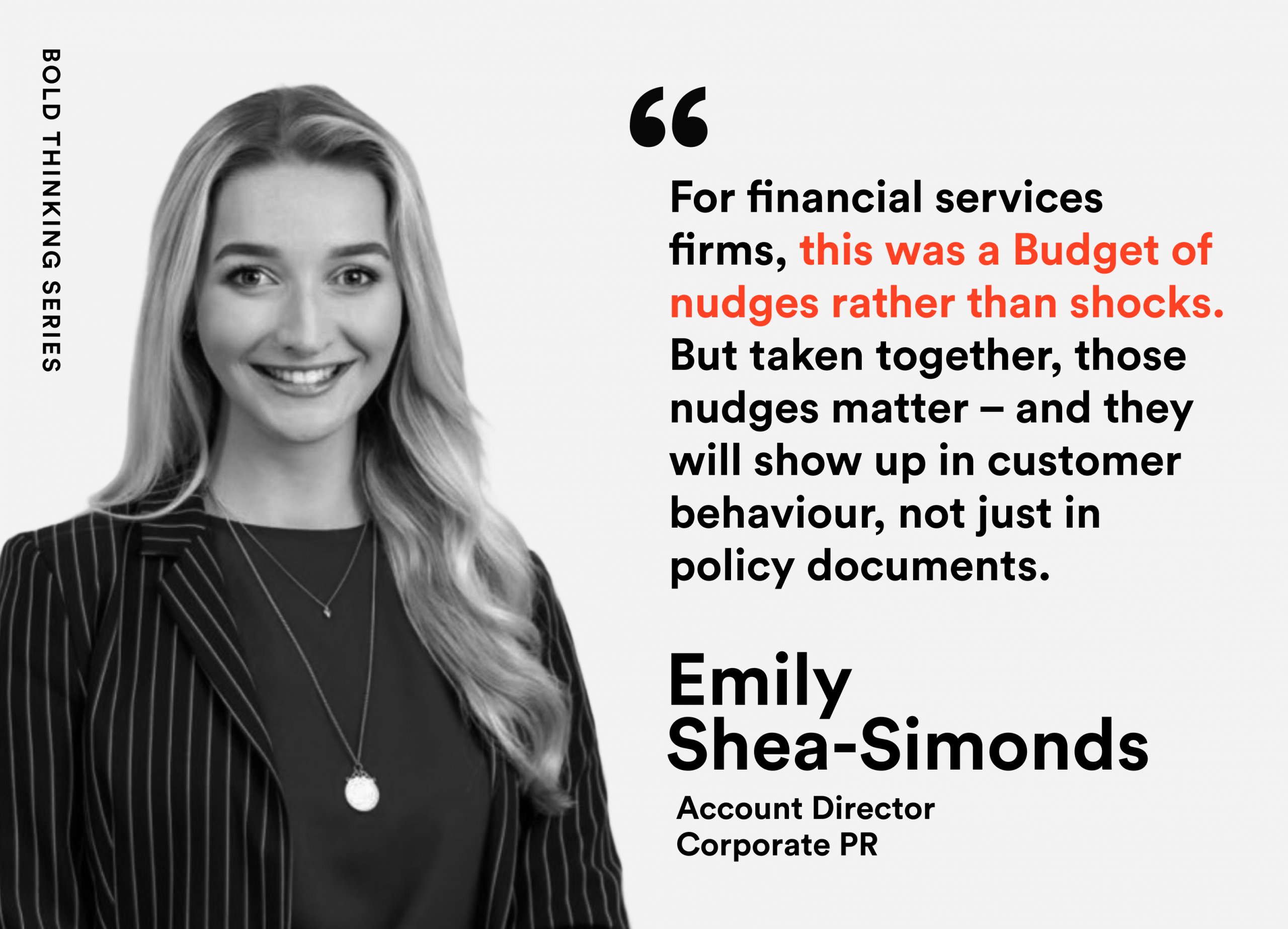
For financial services firms, this was a Budget of nudges rather than shocks. But taken together, those nudges matter – and they will show up in customer behaviour, not just in policy documents.
Three practical priorities for communications teams:
Get ahead of the questions. Build clear, jargon-free explainers on whatever your “issue” is. Package them in formats your frontline teams can actually use – from call-centre scripts to short video or carousel content.
Segment the story. The Budget lands very differently for lower earners, mid-career professionals, landlords, and retirees. Now that we have the reactions out of the way, avoid the one size fits all “what the Budget means for you” responses. Instead, tailor messages to a handful of priority segments and the decisions they’re actually facing.
Own the tone. Political rhetoric will focus on blame. Your role is to focus on agency. Emphasise what customers can do: adjust contributions, review wrappers, build buffers, rethink timelines. The brands that help people feel less powerless – not just better informed – will come out of this period stronger.
A Budget overshadowed by its own fallout
All of this is playing out against a messy backdrop. Rachel Reeves now faces accusations that she misled the public about a fiscal “black hole”, after OBR correspondence suggested the Treasury had been in a stronger position than implied. Whether that critique sticks or not, it reinforces a wider problem: the growing gap between public expectations, political point-scoring and the real fiscal picture.
For firms communicating with clients in this landscape, it’s essential to cut through the noise early, anchor every message in facts rather than speculation, and be ready to update calmly as the politics rolls on.
Because if this year proved anything, it’s that the Budget no longer begins, or ends, at the dispatch box. The story now plays out over weeks. The brands that help people make sense of it, consistently, will be the ones that earn customer trust over the long-term.